


Main Features:
1. Advanced Vector Modulation Capabilities
-
Broadband Generation: Equipped with a 200 MHz internal modulation bandwidth and up to 2 GHz external modulation real-time bandwidth for testing wideband signals.
-
Metrology-Grade Accuracy: Delivers excellent vector modulation precision with an EVM (Error Vector Magnitude) of less than 1.4% (typical <1.0%) for frequencies up to 40 GHz, and <2.5% up to 67 GHz.
-
Universal Format Support: Supports real-time generation of over 20 standard digital modulation formats, including PSK, QAM, FSK, and MSK.
-
Flexible Waveform Editing: Includes a large-capacity (2 G sampling points) waveform storage, allowing users to download and play back complex, long-duration arbitrary waveform data to simulate real-world interference or custom signals.
2. Frequency Range and Spectral Purity
-
Wide Coverage: Frequency coverage ranges from 100 kHz up to 67 GHz (model-dependent: 3 GHz, 6 GHz, 10 GHz, 20 GHz, 40 GHz, 50 GHz, or 67 GHz).
-
Low Phase Noise: Engineered for high-level receiver testing, it offers a typical SSB phase noise of -126 dBc/Hz (10 GHz carrier at 10 kHz offset) and -142 dBc/Hz (1 GHz carrier at 10 kHz offset).
3. Power Performance
-
High Output Power: Capable of high-power output (up to 1W/+30 dBm at 20 GHz with optional hardware), often eliminating the need for external amplifiers in test setups.
-
Wide Dynamic Range: Features a massive 140 dB – 150 dB output dynamic range, making it suitable for testing the sensitivity and blocking characteristics of high-performance receivers.
4. Advanced Pulse Modulation
-
Radar Testing: Specifically optimized for pulse-heavy environments, offering pulse modulation depths greater than 80 dB and rise/fall times under 10 ns.
-
Complex Sequences: Supports sophisticated pulse features like double pulses, pulse bursts, and staggered pulse repetition frequencies, crucial for electronic warfare and radar simulation.
5. Intuitive User Interface
-
Modern Interaction: Features a large 10.1-inch LED touchscreen (1280×800 resolution) with a graphical, window-based menu that simplifies complex setup procedures.
-
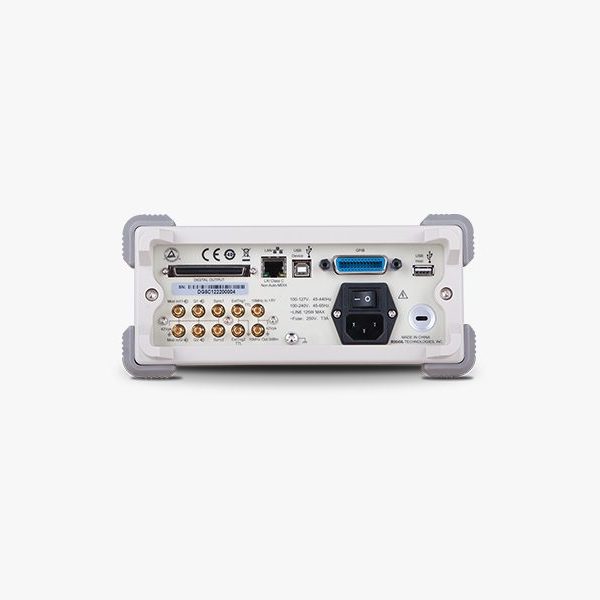
Connectivity: Includes versatile control interfaces for automated testing, such as LAN, USB, and GPIB, and supports SCPI command sets for integration into large-scale ATE (Automatic Test Equipment) systems.
6. Typical Applications
-
Satellite Communication: Providing repeatable, high-reliability signals for transponder and receiver testing.
-
Doppler Radar & EW: Simulating complex interference and multi-path environments.
-
High-End Component/System Testing: Acting as a high-quality local oscillator (LO) substitute or clock source for precise performance validation.






Reviews
There are no reviews yet.