


Main Features:
1. Ultra-Wide Frequency Coverage & Serialization
-
Extended Spectrum: Depending on the specific model within the series, it spans from 100 kHz up to 3 GHz, 6 GHz, 10 GHz, 20 GHz, 40 GHz, 50 GHz, or 67 GHz (with option to select a minimum frequency of 9 kHz and maximum frequency expanding up to 70 GHz on specific configurations).
2. High Spectral Purity (Ultra-Low Phase Noise)
-
Pristine Phase Noise: The series is built for highly accurate local oscillator (LO) substitution and blocking tests. It delivers a typical single-sideband (SSB) phase noise of:
-
-142 dBc/Hz at a 1 GHz carrier (10 kHz frequency offset).
-
-126 dBc/Hz at a 10 GHz carrier (10 kHz frequency offset).
-
-
Spurious and Harmonic Rejection: It features advanced non-harmonic and sub-harmonic suppression to guarantee extremely pure signal output.
3. Broadband and High-Power Output Capabilities
-
Exceptional Drive Levels: It provides standard high-power handling, which can be further amplified using optional upgrades:
-
H05 Option: Yields up to +22 dBm at 20 GHz, +20 dBm at 40 GHz, and +10 dBm at 67 GHz.
-
H06 Option: Pushes the high-power performance up to +30 dBm (1 Watt) at 20 GHz.
-
-
This high direct output eliminates the need for external amplifiers, maintaining superior power accuracy and leveling stability.
4. Immense Power Dynamic Range
-
Extreme Sensitivity Range: Offers a vast 150 dB power dynamic range spanning from -130 dBm to +20 dBm (standard configuration), making it suitable for testing ultra-sensitive wireless receivers.
5. Advanced Modulation Capabilities
-
Analog Modulation: Comprehensive internal and external modulation resources supporting AM (linear depth >90% and exponential modes), FM (DC to 10 MHz bandwidth), and $\Phi$M (Phase Modulation).
-
High-Performance Pulse Modulation: Features a pulse modulation depth greater than 80 dB, rapid rise/fall times under 10 ns, and a minimum pulse width of 20 ns. The built-in pulse generator includes 6 distinct pulse modes and supports complex pulse trains needed for specialized radar simulations.
-
Vector Modulation (1465-V Models): Integrates an internal baseband generator providing a 200 MHz internal vector modulation bandwidth and up to 2 GHz external modulation real-time bandwidth. It yields an Error Vector Magnitude (EVM) of less than 1.4% across universal digital modulation schemes (QAM, PSK, FSK, ASK).
6. High Frequency & Power Stability
-
Rock-Solid Time Base: Features a highly stable internal reference with a time-base aging rate of $\pm5 \times 10^{-8}/\text{year}$ (and less than 0.5 Hz variation per year for its 10 MHz high-stability time-base).
-
Thermal Rigor: After continuous power-on cycles over a 15-day stretch through shifting temperatures ($0^\circ\text{C}$ to $50^\circ\text{C}$), the absolute power variation remains under 0.2 dB.
7. Modern Interface and Graphic Guidance
-
Large Touchscreen Layout: Equipped with a bright, 10.1-inch LED display supporting a 1280×800 resolution.
-
Flexible UI Controls: Features color-coded menus and an interactive graphical signal-flow diagram that visualizes parameter changes intuitively. Controls can be manipulated via the touch panel, manual entry knobs, physical shortcuts, or an attached mouse/keyboard.
-
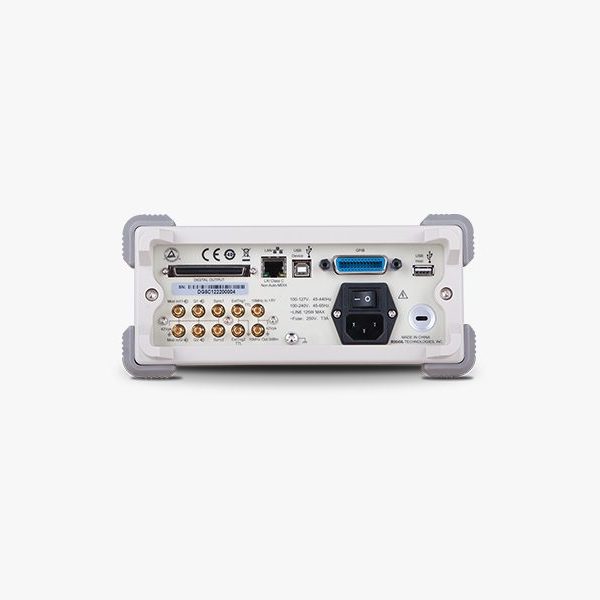
Control Interfaces: Comes standard with LAN, USB, and GPIB (IEEE-488) connections for easy multi-client automated deployment using SCPI commands.






Reviews
There are no reviews yet.